The hard part of a municipal water project in Southeast Asia is never simply which pipe to use. Two transmission mains with the same nominal diameter can face completely different groundwater conditions, monsoon rainfall, coastal salinity, shipping routes and site construction constraints. A low-lying coastal zone, an island scheme, an urban pump station and a long-distance raw water line are four different engineering problems.
That is why SSAW (spiral submerged arc welded) steel pipe cannot be selected on diameter and price per metre alone. For raw water transmission, municipal distribution mains, treatment plant inlet and outlet lines, and pump station tie-ins, buyers need to fix four things at the same time: pipe dimensions and steel grade, internal lining, external corrosion protection, and field joint coating requirements.
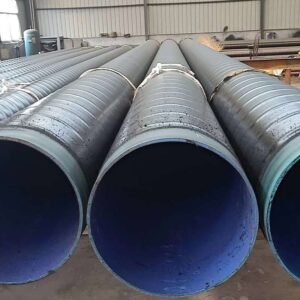
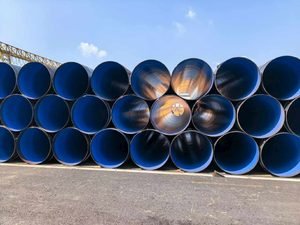
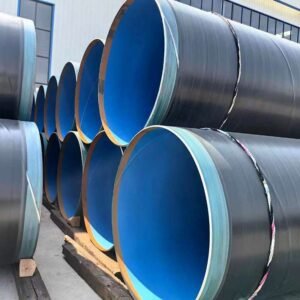
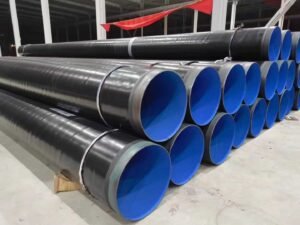
Youcheng supplies spiral welded steel pipe from OD 219 mm to 3800 mm and can support third-party inspection. For Southeast Asian municipal water projects, we build the confirmed combination: cement mortar internal lining with an external paint system, an external plastic coating, or an external 3PE (three-layer polyethylene) coating.
Start With Service Conditions, Not With a Country Template
“Southeast Asia” is neither a steel grade nor a coating class. It is a reminder to write heavy rainfall, groundwater, coastal chlorides, the transport route and site construction conditions into the technical agreement.
| Service condition | SSAW pipe selection focus | Internal lining focus | External coating focus |
| Long-distance raw water or municipal transmission mains | Design flow sets OD; design pressure and external loads set wall thickness | Cement mortar lining is common; confirm against water quality and project specification | Check soil, groundwater, backfill abrasion and field joint coating |
| Treatment plants, pump stations and valve chambers | Fittings, flanges, dimensional accuracy and installation space | Keep the lining continuous across tees, reducers, flanges and girth welds | For above-ground or equipment areas, specify the paint system, weathering resistance and maintenance requirements |
| Coastal, island and flood-prone low-lying areas | Transport segmentation, lifting, field welding and buoyancy control | Confirm against water quality, salinity and project specification | High humidity, groundwater and salt spray do not justify reducing external coating or field joint requirements |
| River, wetland or soft-ground crossings | Pipe body strength, installation method, buoyancy and settlement control | Define by conveyed medium and design requirements | Confirm external coating, field joint coating, anti-flotation measures and backfill protection in the crossing design |
Across the region, cities are investing in water supply, drainage and climate-resilient infrastructure. Coastal areas add saltwater intrusion, flooding and year-round high humidity. For a water transmission main, external coating, pipe-end protection and field joint coating therefore belong in the technical specification, not in a footnote to the quotation.
Specifying SSAW Steel Pipe: Start With Hydraulics and Installation
Spiral welded steel pipe suits a wide range of large-diameter water transmission projects. At enquiry stage, define at least OD × WT × length, steel grade, applicable standard, pipe end configuration, inspection requirements and transport conditions.
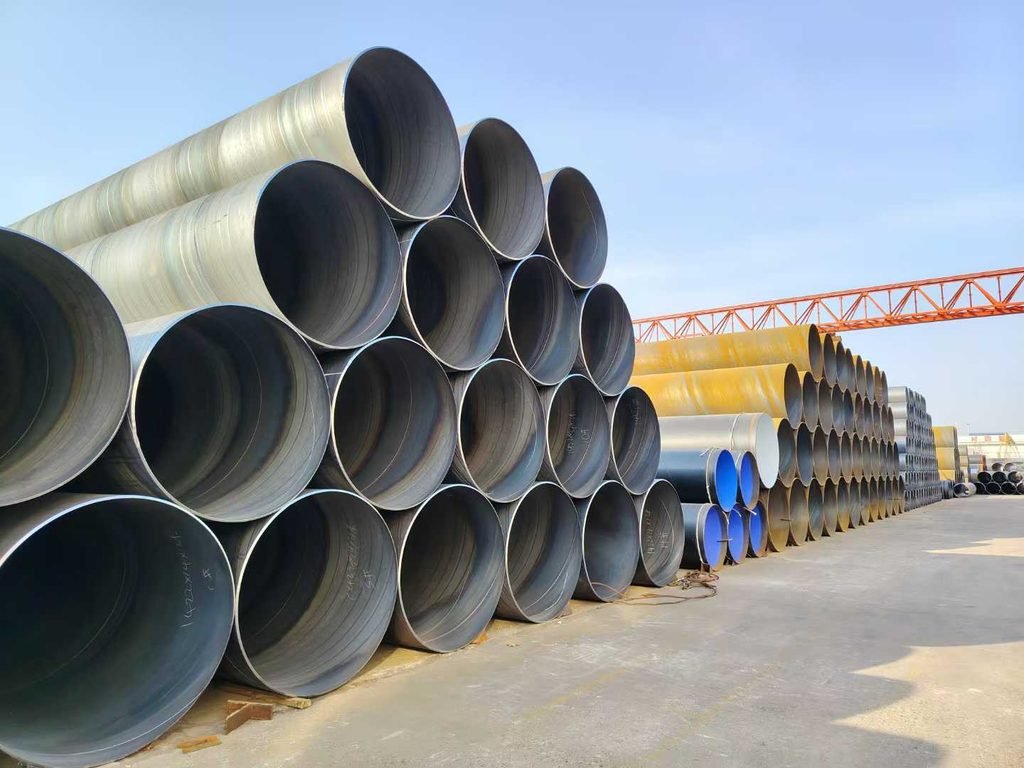
Outside Diameter Is Set by Design Flow, Not by Bigger-Is-Better
OD should be fixed against design flow, velocity, pump capacity and future capacity expansion. A larger diameter increases hydraulic capacity, but it also increases single-pipe weight, port unloading, road transport and on-site lifting difficulty.
For large-diameter schemes, see the supply scope of our large-diameter spiral steel pipe. Final dimensions must still follow the hydraulic calculation, the project design and the transport limits.
Wall Thickness Is Driven by Internal Pressure and External Loads Together
A municipal transmission main cannot be sized on working pressure alone. Burial depth, traffic loads, soft soil, groundwater, lifting, backfill and local differential settlement all affect wall thickness and corrosion allowance.
The designer should first issue the pressure class, wall thickness and any required corrosion allowance. The supplier then confirms coil availability, pipe forming, unit weight, the loading plan and field constructability.
Pipe End Configuration Determines Field Joint Difficulty
Butt-weld ends, flanges, socket joints or other connection types directly affect field fit-up, lining termination, external field joint coating and the hydrostatic test method. Writing only “steel pipe for water” on an RFQ is not enough: pipe end geometry and the field joining method must be defined before quoting.
Cement Mortar Lining for Municipal Water: Write It Separately
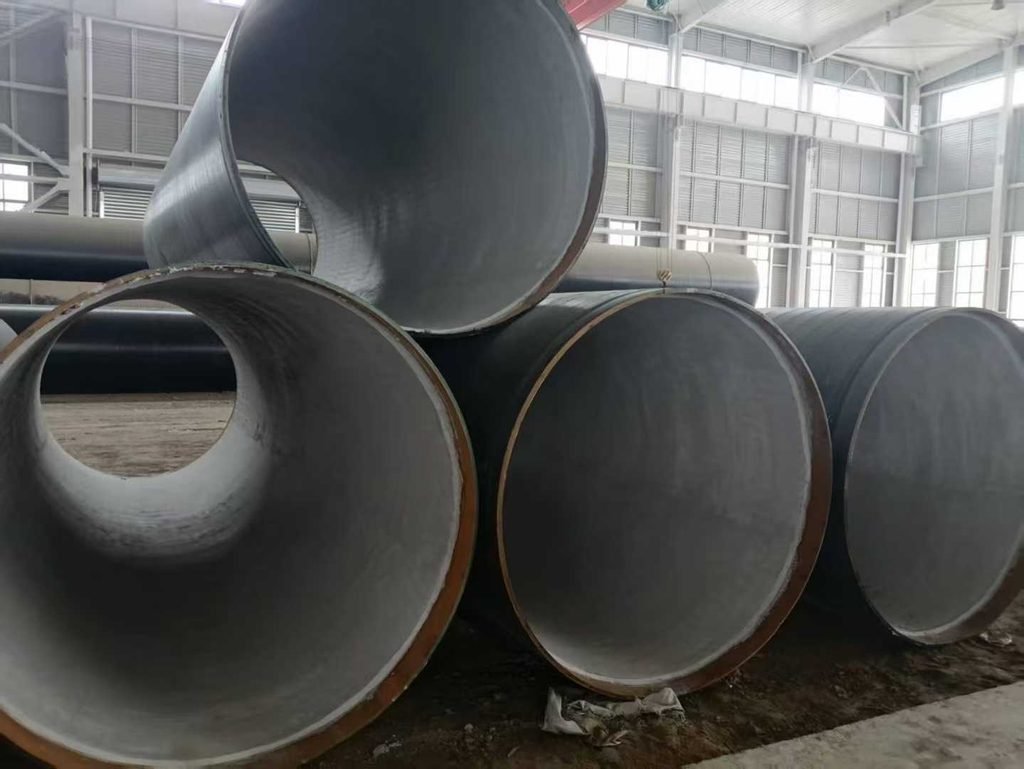
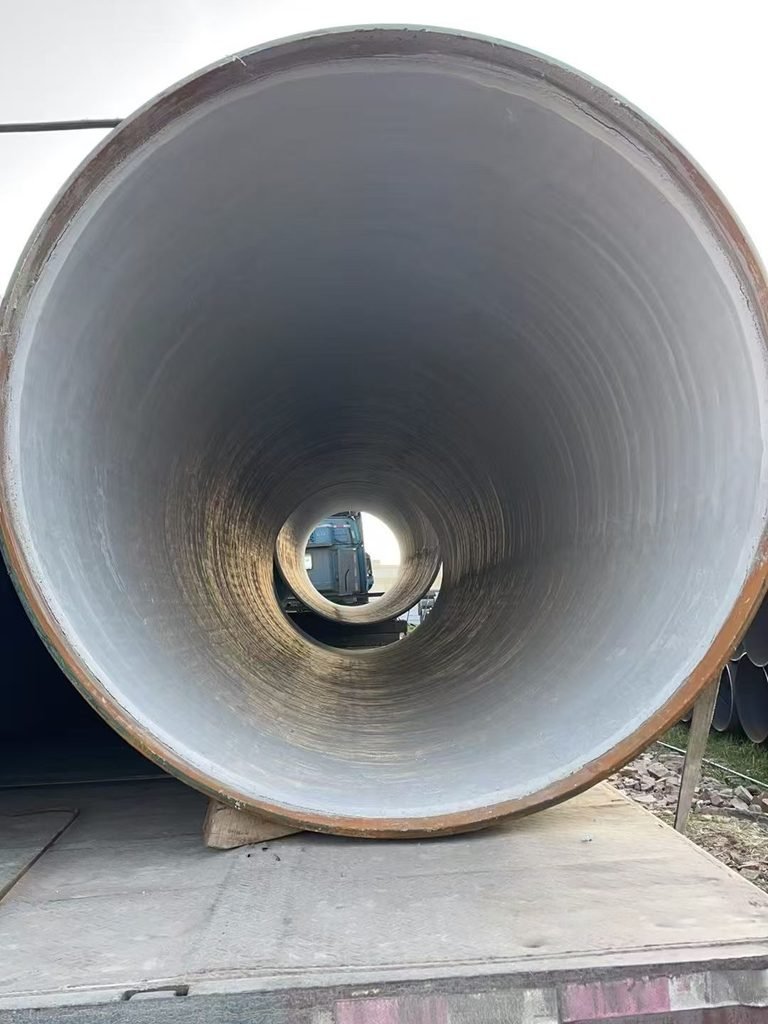
For municipal raw water and distribution mains, cement mortar lining (CML) is normally the first internal protection option to evaluate. It protects the internal steel surface and provides a bore suitable for water service.
CML is intended for municipal water supply, raw water transmission and waterworks projects. It should not be carried over without verification to high-temperature, highly corrosive, oil and gas, or highly abrasive media.
When cement mortar lined steel pipe is used on a water project, the technical agreement must say more than “cement mortar lining”. Specify lining thickness, curing requirements, pipe-end termination, restoration of the lining at field joints, and the acceptance documents.
AWWA Standards Commonly Referenced on Water Projects
Southeast Asian projects are ultimately governed by the owner’s specification, local regulations and the contract. Where a project follows the AWWA waterworks system, the following standards normally need to be confirmed in the technical agreement:
| Standard | Scope |
| AWWA C200-23 | Base standard for steel water pipe 6 in. (150 mm) and larger |
| AWWA C205-24 | Shop-applied cement mortar protective lining and specified external mortar coating for steel water pipe 4 in. (100 mm) and larger |
| AWWA C206-23 | Field welding of steel water pipe |
| AWWA C207-23 | Waterworks steel pipe flanges for pump stations, valve chambers and equipment connections |
| AWWA C208-22 | Dimensions for fabricated steel water pipe fittings: elbows, tees, reducers and specials |
| AWWA C210-24 / C213-22 | Liquid epoxy or fusion-bonded epoxy (FBE) internal and external protective systems |
| AWWA C215-26 | Extruded polyolefin external coatings |
Standards do not replace project design. Before quoting, confirm whether the owner works to AWWA, ISO, EN, BS or a local code, then prepare MTCs, inspection reports, lining records, external coating records and third-party witness documentation to the specified edition.
External Protection: Cement Mortar Inside, Paint / Plastic Coating / 3PE Outside
Cement mortar lining solves the internal problem. External protection must be selected separately against the installation environment.
| External environment | Options to evaluate | What to confirm in the technical agreement |
| Above-ground lines, pump stations, plant equipment areas | Paint system or owner-specified external coating | Primer, topcoat, dry film thickness, colour, weathering resistance and field touch-up |
| Conventional buried water mains | External plastic coating, epoxy or owner-specified external coating | Coating material, thickness, holiday detection, pipe-end cutback and field joint coating |
| Long buried runs, wet soil, groundwater, or high risk of handling abrasion | 3PE external coating | 3PE standard, class, layer thickness, joint coating material, inspection and transport protection |
| River, wetland, soft ground or special crossings | Project-specific protection design | Anti-flotation, installation method, external coating, girth weld coating and backfill protection |
For municipal water projects, Youcheng can supply three confirmed combinations:
- Internal cement mortar lining + external paint system: for above-ground lines, pump stations, plant areas and owner-specified painting environments.
- Internal cement mortar lining + external plastic coating: where protection on both surfaces, joint management and waterworks package requirements apply.
- Internal cement mortar lining + external 3PE: for long buried mains in wet soil or groundwater, or where the outer layer needs high mechanical protection.
3PE provides external corrosion and mechanical protection; it does not replace cement mortar lining. “Internal cement mortar + external 3PE” is a valid option for mains needing protection on both sides. For 3PE details, see our 3PE coated SSAW steel pipe.
Where a project calls for coating on both surfaces, or sets specific potable-water requirements, large-diameter plastic-coated steel pipe is also worth evaluating. What matters is not the phrase “plastic-coated”, but which material is used inside and out, at what thickness, and to which acceptance standard.
Where Southeast Asian Projects Fail: Transport and Field Joint Coating
A large-diameter pipe can travel from the mill to site by ocean freight, port transfer, short-haul island transport and a second lift on site. However good the factory-applied coating is, if girth weld coating and unloading protection are not written into the same Inspection and Test Plan (ITP), the weakest point of the line stays in the field.
Confirm the following before procurement and construction:
- Whether individual pipe length and weight suit the destination port, road limits and site lifting capacity.
- Whether the external coating needs pipe-end protectors, timber dunnage, anti-roll chocks and padded lifting slings.
- Which field joint coating material is used on girth welds, and who performs and accepts the work.
- How the internal lining is restored at joints, and whether CCTV inspection or other acceptance records are required.
- Whether batch delivery sequence matches the laying sequence, to avoid long open-air storage.
- Which processes, documents and records the third-party inspector must witness.