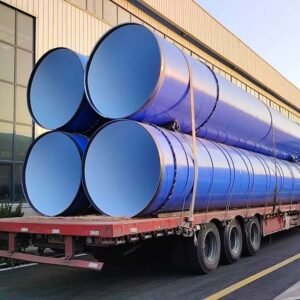
On a buried water main in a peri-urban district of Southeast Asia, a specification can put two systems on the same drawing: 3PE external coating alone, or 3PE external coating with an internal epoxy lining added (called TPEP in the Chinese market). Diameters on a line like this fall in the 219–3800 mm range, welded up from SSAW pipe, under a water table that climbs sharply in the monsoon months and through soil of mixed clay and sand with rocky pockets. The buyer’s decision here is a procurement one, covering which surfaces the order includes and what the site asks of each. That is the choice this note works through.
The naming causes confusion in enquiries, though the practical question is simpler than the vocabulary: does the order need an internal lining, and if so, who supplies it. TPEP is a name used in the Chinese market; international specifications usually express the same build descriptively as external 3PE with an internal epoxy lining. Our published note on how the two systems differ covers the definitions. Here we stay with the site conditions that drive the choice and the wording that makes the chosen scope enforceable.
Let the site conditions decide
Start with the soil side. Aggressive clay, a high groundwater table and stray current all load the external build, so the epoxy primer’s resistance to cathodic disbondment and the polyethylene topcoat’s resistance to rock damage and compaction do most of the work there. 3PE external coating to DIN 30670, ISO 21809 or AWWA C215 handles that duty on its own when the internal lining is written under a separate item. The build can be applied to straight-seam pipe, but Youcheng manufactures SSAW and in this diameter range that is the route we quote.
Then look at the water side. Treated water held in a large-diameter main for long residence times makes a smooth epoxy lining worth specifying, and a design that wants both surfaces under one specification is where a 3PE build with an internal lining is justified. That combined build adds a shop-applied internal lining to the 3PE external build, with the field joint lining applied after welding, so the supply scope is wider. The distinction between the two options is whether a lining is included in the order.
The third factor is site logistics. If an internal lining contractor is already mobilised, a 3PE external order keeps the scope clean and the inspection focused on one system. If there is no lining crew on site, one order covering both surfaces avoids bringing in a second contractor. On the municipal water mains we are asked to quote, that single-supplier reason comes up more often than any performance argument.
Joints and inspection stay decisive
Joint coating deserves the same attention as the plant-applied layers. On a line with an internal lining the field weld interrupts both surfaces: a heat-shrink sleeve goes on the outside, and an internal joint lining goes in after welding. A 3PE external order needs the external sleeve only. Ignoring the joint turns a sound coating into a chain of weak points. Pipe end preparation matters as well: a defined bare length at each end lets the crew weld without burning the PE, and the bevel has to match the welding procedure.