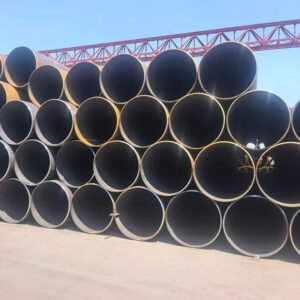
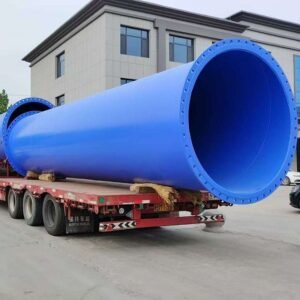
A coastal intake main leaves the works, crosses a band of tidal flats, and runs buried through saline ground before it reaches the shoreline. Diameters on a line like this fall in the 219–3800 mm range, welded up from SSAW pipe into long strings. Three exposures meet on one alignment: salt-laden air on any above-ground stretch, a wet-and-dry tidal band where the level moves twice a day, and buried length sitting in groundwater with a high chloride content. The coating has to hold up in all three.
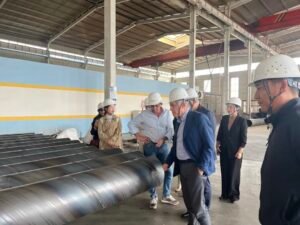
This is the setting in which a multi-layer coating system, usually three-layer polyethylene (3LPE), gets written into the specification. The label is used loosely from time to time, so the first engineering job is to pin down what each layer does and how the whole build is checked before it leaves the plant.
What each layer is doing
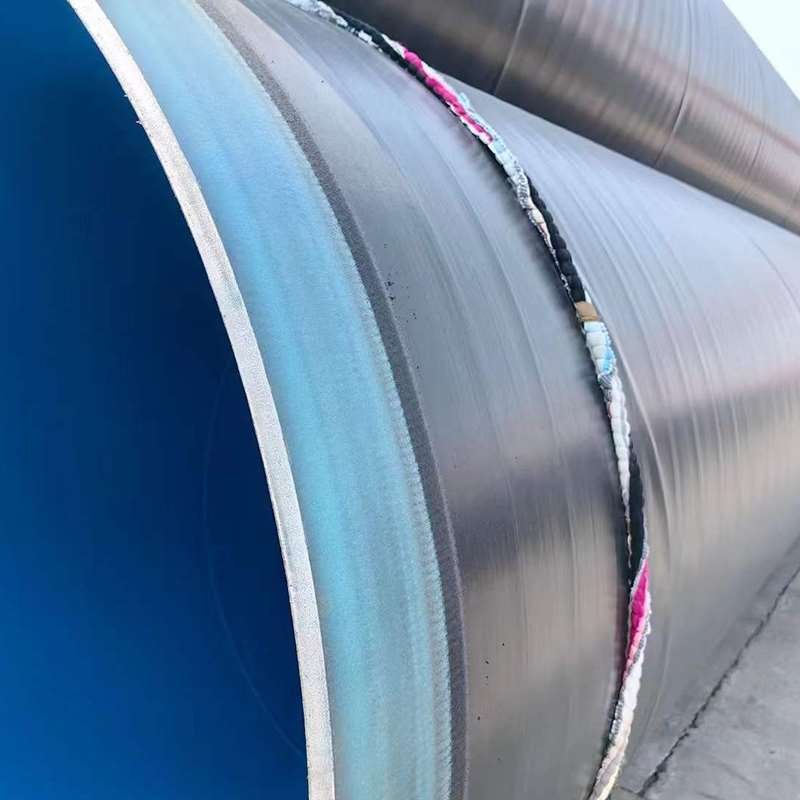
Each layer in a 3LPE build has a specific job: a fusion-bonded epoxy primer for steel adhesion and resistance to cathodic disbondment, a copolymer adhesive that ties it to the outer layer, and an extruded polyethylene topcoat that takes impact and blocks moisture and chlorides. Our note on 3PE coating on a steel water pipe describes the build in more detail. DIN 30670, ISO 21809 and AWWA C215 cover this external structure.
Why the tidal band drives the choice
The buried stretch is demanding enough, but the splash and tidal band is where coatings are most often defeated. Wet-dry cycling drives salts against the surface, and any holiday or thin spot becomes a starting point for corrosion under the film. A single thin epoxy layer may cope on the buried section and still struggle here. The PE topcoat of a 3LPE system stands up to that cycling and to the abrasion that comes with it, which is why the multi-layer build keeps appearing in coastal intake specifications. Where designers weigh a single epoxy against three layers, the FBE versus 3PE comparison is a useful starting point.
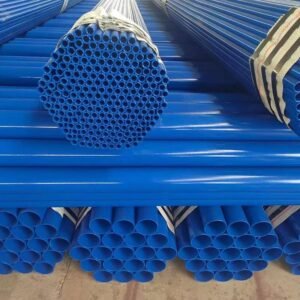
The inside of the line is a separate decision. Seawater intake mains are commonly lined internally with liquid epoxy to AWWA C210, both to control corrosion and to keep friction low over a long service life. A combined build — external 3LPE with an internal liquid-epoxy lining — delivers both surfaces in one order; it is commonly called TPEP in the Chinese market. Whether to call for that combined build or for external 3PE alone depends on whether the internal lining is already covered elsewhere in the specification.