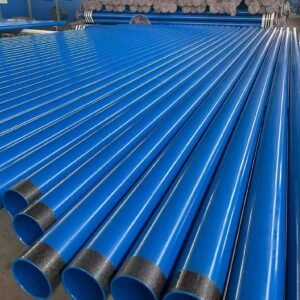
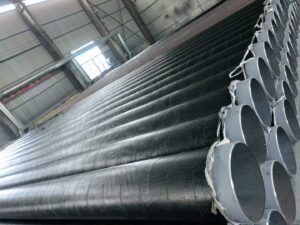
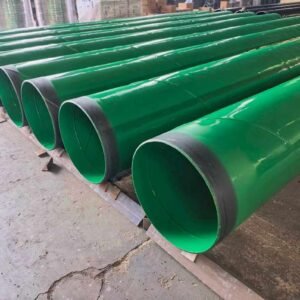
A water utility in sub-Saharan Africa faces a transmission problem: a river intake at one end, a service area at the other, and kilometres of ground between. The main is buried end to end, through red lateritic soil turning to expansive clay, with a high water table in the rainy season and heat the rest of the year. Once the main is buried, the coating cannot be inspected without excavating it, so it has to survive both the handling and the years in wet ground. That is why 3LPE coated steel pipe is commonly specified for this duty.
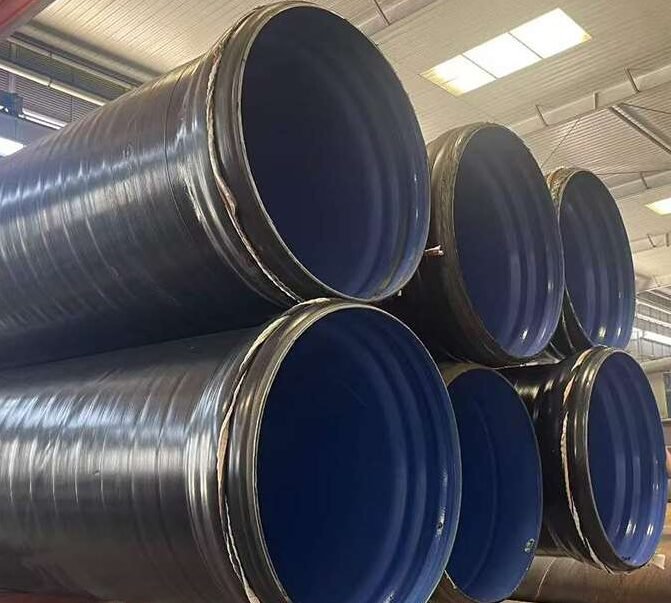
I. Why an African Water Scheme Ends Up Specifying 3LPE
On an African water project, the first reason for choosing three-layer polyethylene is mechanical, not chemical. A large-diameter water transmission main is delivered in single lengths that are lifted, chocked, trucked over poor roads, stacked and lifted again before it is lowered into the trench. A primer-only system specified for corrosion resistance alone will not survive that sequence. The polyethylene jacket over the epoxy primer absorbs impact and abrasion in a way that a primer-only system cannot.
The second reason is the ground. Where the water table is high and the backfill stays wet for part of the year, the coating has to stay bonded and impermeable under continuous immersion; before dispatch that is checked by holiday testing the coated pipe at the voltage named in the specification. A coated spiral welded pipe in this condition is judged on two things: whether the layer build-up matches the class named in the specification, and whether the field joints were closed to the same standard. Those two decide whether the line is one continuous barrier or a series of coated spools. SSAW pipe is available up to 3800 mm OD, where a length carries a much larger coated surface and more handling weight than small line pipe, so consistent application and inspection matter more than the nominal class alone.
II. What the Three Layers Actually Do
The first layer is a fusion bonded epoxy primer applied to a blasted steel surface. It provides the adhesion and the barrier at the metal interface. The second is a copolymer adhesive that bonds the primer to the outer jacket; without it the polyethylene would simply lift. The third is the polyethylene jacket, which carries the mechanical and moisture protection and defines the impact resistance of the system.
Because the layers work as a system, a 3LPE coated pipe cannot be assessed from a single thickness number. The clause has to name the standard, the coating class within that standard, the pipe-end cutback length and the field joint system — see our guide on what coating thickness the standard requires. Common references are AWWA C215 and, where the owner adopts them, DIN 30670 or ISO 21809, with ISO 21809-3 for field joint coatings. A quotation that says only “3LPE coated” tells a buyer nothing about whether the pipe will pass a holiday test after a long truck haul and a second lift.
III. Where the Specification Usually Goes Wrong
Three failures recur in the water-main enquiries we handle. The first is a coating standard named without a class, which leaves the mill free to choose the lightest compliant build-up. The second is a field joint clause that names no responsible party: the SSAW pipe arrives correctly coated, the girth welds are coated by the EPC contractor with a material from a different family, and the corrosion barrier is broken at the girth weld.
The third is transport. A 3LPE coated pipe that leaves the mill with a clean holiday test record can arrive damaged if end protectors, timber dunnage, anti-roll chocks and padded slings are not written into the packing plan. On a route that includes rough roads and more than one handling, that damage is not always visible at the delivery point, and the repair record has to follow the pipe number. For a water transmission main, the coating record and the hydrostatic test record should travel with each length, not sit in a separate file at the port.
Use this clause checklist when reviewing a 3LPE quotation for a buried water main:
| Clause | What the technical agreement should state | Why it decides the outcome |
|---|---|---|
| Governing standard | Named coating standard, edition and class | Fixes the layer build-up and test scope |
| Surface preparation | Blast grade before primer application | Adhesion at the steel interface |
| Coating class | Class matched to soil and groundwater conditions | Prevents under-specification in wet ground |
| Pipe-end cutback | Cutback length matched to the joint system | Prevents a bare or overlapped joint |
| Field joint | Material family, applicator and acceptance record | The joint is the weakest point of the line |
| Inspection and packing | Thickness and holiday test per pipe, plus end protectors and dunnage | Survives the rough haul and second lift |
IV. What to Put in the Coating Clause
Name the standard, the class, the cutback and the joint, then make the transport plan part of the coating clause. Youcheng supplies large-diameter spiral steel pipe, 3PE coated SSAW steel pipe and spiral welded steel pipe, with per-pipe coating and test records for water transmission main projects. Related: 3PE vs TPEP coating; what is 3PE coating; steel pipe hydrostatic test. Send your diameter, pressure class, soil and groundwater conditions and we will return an external-coating comparison for your African water project. Send your enquiry via WhatsApp (wa.me/8615720301466) or by email to sean@youchengpipe.com.