Force main coating on a buried wastewater line: the decisions that matter
On a buried wastewater alignment in Southeast Asia, a gravity sewer often turns into a force main where the ground rises or the discharge point sits below the hydraulic grade. The bore stops running partly full and starts running under pressure. That change alters what the coating system has to do. This note follows the coating and lining decisions in the order an engineer meets them, and flags the errors that appear most often in the enquiries we handle.
A gravity main flows with a free surface, partly full, at roughly atmospheric pressure. A force main is closed and full, and the pump sets the head. The distinction drives material selection. On the force main the steel stays in continuous contact with the effluent, and dissolved sulfide drives internal corrosion along the whole full-flow length. Sulfuric acid forms only where sulfide collects in a gas pocket at a high point or a low-flow reach; a full barrel has no crown gas space. The outside of the same pipe carries soil load and sits in groundwater. Coating only the outside, or only the inside, leaves one side of that exposure untreated.
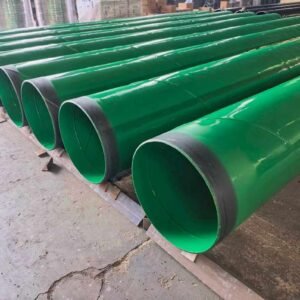
Internal protection is usually the first call. On a sulfide-bearing wastewater main we would look at a shop-applied liquid epoxy lining to AWWA C210; the lining separates the steel from the effluent along the full-flow length. Cement mortar is reserved for sulfide-free water or stormwater pressure mains where the bore and flow regime suit it, and is not used for this duty. Youcheng supplies epoxy-lined pipe and cement mortar lined steel pipe for the respective duties. Surface preparation and cure govern the result more than the product name on a datasheet. A lining applied over mill scale will come loose whatever its chemistry.
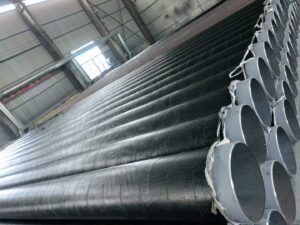
External coating is chosen against the trench conditions. High groundwater and aggressive clay point toward a three-layer system: a fused epoxy base, an adhesive, and a polyethylene top layer. We specify 3PE to AWWA C215, DIN 30670 or ISO 21809 and supply it on our own spiral welded body as 3PE coated SSAW steel pipe, in OD 219–3800 mm. Where the trench is well drained and backfill is controlled, a single FBE coated steel pipe to AWWA C213 can be enough. The two systems are set side by side in our FBE versus 3PE comparison.
One constraint we state early: Youcheng manufactures SSAW, so large buried mains in this range are supplied as spiral welded steel pipe. LSAW appears only in comparisons; where a specification names it, we check whether the intent is wall, weld quality or delivery length and answer against SSAW.
Field joints and holiday detection
The plant coating ends at the weld bevel. What happens over the field joint decides whether the line behaves like a coated pipe or a collection of coated spans joined by bare steel. On a 3PE line we use a heat-shrink sleeve with an epoxy primer that bonds to both the epoxy base and the polyethylene layer; on an FBE line the repair is a compatible fusion-bonded or liquid epoxy. Matching the repair material to the mainline system is the clause buyers most often leave out.
Pipe ends need a coating cutback so welding does not burn the film, and a defined bevel preparation for the weld. Too generous a cutback leaves a long bare band to be recoated on site; too tight a cutback damages the coating at the heat-affected zone. Before backfill, the coated surface and the joints get a holiday (spark) test. We cover what that test proves, and where its limits are, in our note on the hydrostatic test and inspection checks.
A specification checklist for the buried force main
| Item | What to call out in the specification | Why it matters on a force main |
|---|---|---|
| Pipe body | SSAW, OD 219–3800 mm, API 5L PSL2 where pressure requires it | Carries internal head plus external soil and groundwater load |
| Internal lining | Shop liquid epoxy to AWWA C210 for sulfide service | Handles dissolved sulfide and internal corrosion under continuous contact |
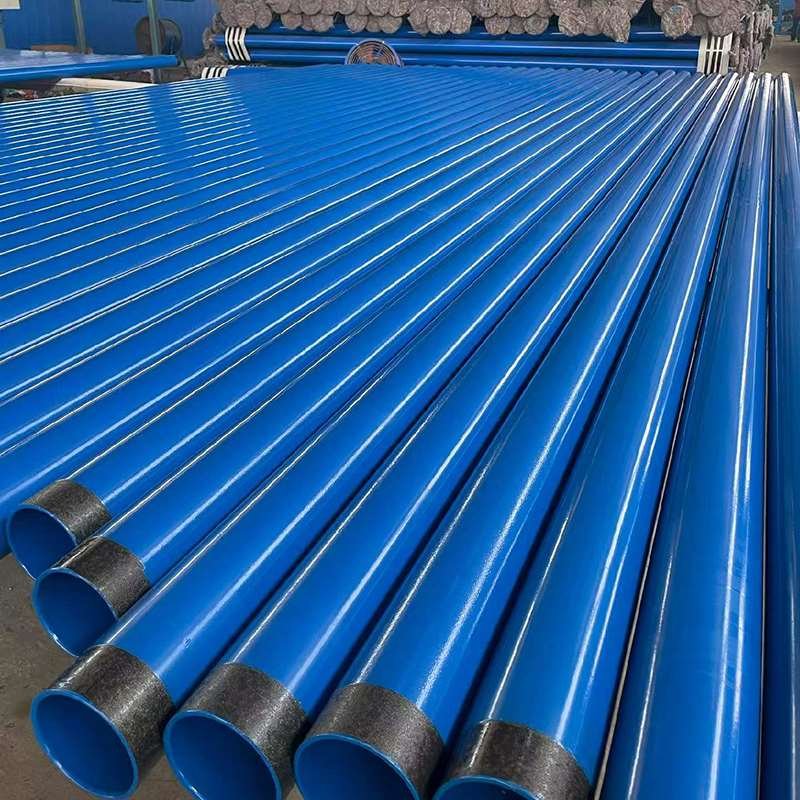
| External coating | 3PE to AWWA C215 / DIN 30670 / ISO 21809, or FBE to AWWA C213 | Separates the steel from aggressive soil and groundwater |
| Field joints | Sleeve or repair epoxy matched to the mainline coating | The bare weld zone is the weak point if left unmatched |
| Inspection | Holiday (spark) test on coating and joints before backfill | Pinholes become corrosion cells once buried |
| Pipe ends | Defined cutback and bevel shown on the drawing | Protects the film from welding heat without over-stripping |
Mistakes we keep seeing
Three errors recur. The first is specifying a coating by brand name with no governing standard, so thickness class and holiday test method are undefined. The second is treating the field joint as a site consumable rather than part of the coating system, with no approved procedure or test. The third is ignoring internal chemistry: a force main with sulfide generation needs an internal lining chosen for that exposure, and the external coating does nothing about it. On the first point, our note on coating thickness requirements is the reference we normally send.
Clauses worth writing into the order
Ask for the governing standard and thickness class by name; the epoxy, adhesive and top layer of a 3PE system should each be identified. State the field-joint material, its application procedure and the holiday test method. Require the lining to be accepted on its own terms — cure and dry-film check — separately from the external coating, with a report tied to pipe number. Define the cutback width and bevel on the drawing, not on site. Keep lining cure and coating adhesion as hold points before the pipe is loaded.
Get these into the purchase specification and the coating becomes a defined deliverable; leave them out and even a good factory film ends up with weak joints and an untested lining. Define the system by standard, thickness class and joint detail before the pipe goes into the ground.
For a coating or lining specification review on a buried force main, reach us on WhatsApp or at sean@youchengpipe.com. Send the diameter range, soil and groundwater conditions, and the internal effluent chemistry, and we will comment on the coating and joint detail.